Fixtures / Tombstone fixtures
Tombstone and multi-station fixtures
A tombstone only pays when the machine is the constraint. If the machine is waiting for an operator, four faces of work in progress are four faces of parts not being made.
At a glance
What it is: a four-sided column — or a multi-station plate — mounted on an HMC pallet, carrying several parts per face, so that one pallet load produces a batch instead of a part.
Price band: USD 16,000–45,000 FOB China for a hydraulic multi-station pallet set. The range is wide because station count, whether pallets are included, and how much of the datum scheme is new all move it.
Lead time: 8–14 weeks, because every station has to be proven, not just the first.
The real constraint: pallet-to-pallet repeatability. If two pallets locate to different positions, the machine cuts two different parts and the four-face advantage disappears.
Build the pallet set as a set. One pallet made well and three set by eye is a machine that produces scrap on three faces out of four.
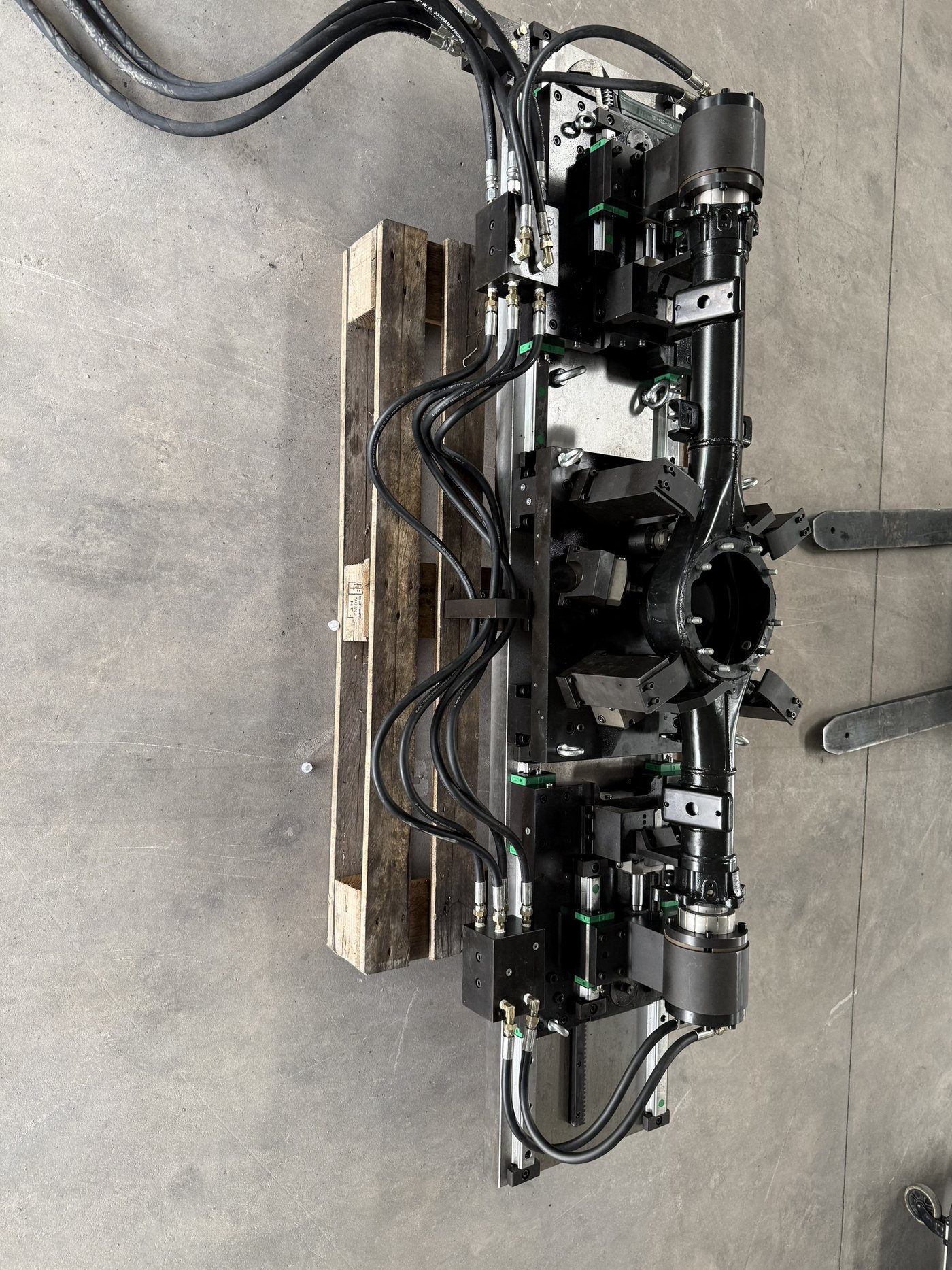
What can be specified
| Item | Range |
|---|---|
| Configuration | 4-face column, 2-face angle, or flat multi-station plate |
| Stations | 4 to 24 parts per pallet load, depending on part size |
| Pallet | 500 × 500 mm or 400 × 400 mm; pinned location on taper pins plus centre pull-stud |
| Repeatability | Pallet-to-pallet typically within 0.01 mm when the pin location is ground and checked |
| Clamping | Hydraulic or pneumatic, with confirmation per station |
| Mass | Fixture mass counts against the pallet load rating — 500 kg evenly distributed on a 500 mm pallet |
| Envelope | Entire assembly must stay inside the pallet outline; anything proud fouls the changer |
| Pallet ID | Recommended: read by the machine so the program knows which pallet is in the work zone |
| Delivery package | Drawings per station, BOM, circuit, M-codes, trial-cut report per pallet, pin-location check sheet |
Figures marked “typical” are the values this class of fixture normally holds in production. Actual values are fixed on the drawing, not on this page.
The arithmetic that decides it
A tombstone is a trade: setup time per part falls, and fixture cost, pallet cost and prove-out time rise. It pays when:
- Parts per year are high enough that the setup time saved exceeds the fixture cost inside one or two years.
- The machine has a pallet changer — without one, a tombstone is just a heavy fixture.
- The part fits four faces without hitting the housing at any index angle.
- Someone loads pallets offline. If the operator loads the tombstone in the machine, nothing has been gained.
Run those four as a checklist before the design starts. Two of them failing usually means the money belongs in a second machine instead.
Where tombstones go wrong
Height. Every station stacked upward spends the machine's Y envelope on fixture. A tall column with parts near the top of the pallet has less reachable travel than the specification suggests, because the tool has to come from above.
Mass. A column with 16 hydraulic clamps, a manifold and 16 parts is not light. The pallet rating is for evenly distributed load, and a tombstone is not evenly distributed — it is a column.
Prove-out. Every station has to be cut and measured, not just station one. A pallet set where three stations were never trial-cut is a pallet set that will find its error in production.
What this is not for
- Not without a pallet changer. The economics depend on loading while cutting.
- Not for parts that need five faces or five axes. That is a different machine and a different fixture.
- Not for a first article run. Prove the part on a single-station fixture, then scale to a tombstone.
Send a drawing. Get a clamping scheme and a price band.
What speeds this up: the workpiece drawing (STEP plus a PDF with datums and tolerances), the machine model, the operation sequence, the cycle time you are targeting, and the annual quantity. Without those you get a band; with them you get a number.