Fixtures / Pneumatic fixtures
Pneumatic clamping fixtures
Pneumatic clamping is fast, clean and cheap to run — and it is the wrong choice the moment the cut needs force a 6 bar line cannot deliver. Knowing where that line sits is the whole decision.
At a glance
What it is: a fixture using pneumatic cylinders, air vises or diaphragm clamps, fed from the shop air line at 0.5–0.7 MPa, actuated by solenoid valves and confirmed by pressure switches.
Price band: USD 4,000–9,000 FOB China for a dedicated pneumatic fixture, depending on station count and whether a valve terminal and clamp confirmation are included.
Holding force: roughly 3–12 kN per clamp depending on bore and line pressure — adequate for aluminium and light steel cuts, marginal for heavy roughing.
Lead time: 5–8 weeks from approved drawing.
Below about 0.4 MPa at the clamp, a roughing pass will move the part. If your shop air sags under load — and most do — put a regulator and a gauge at the fixture, not at the wall.
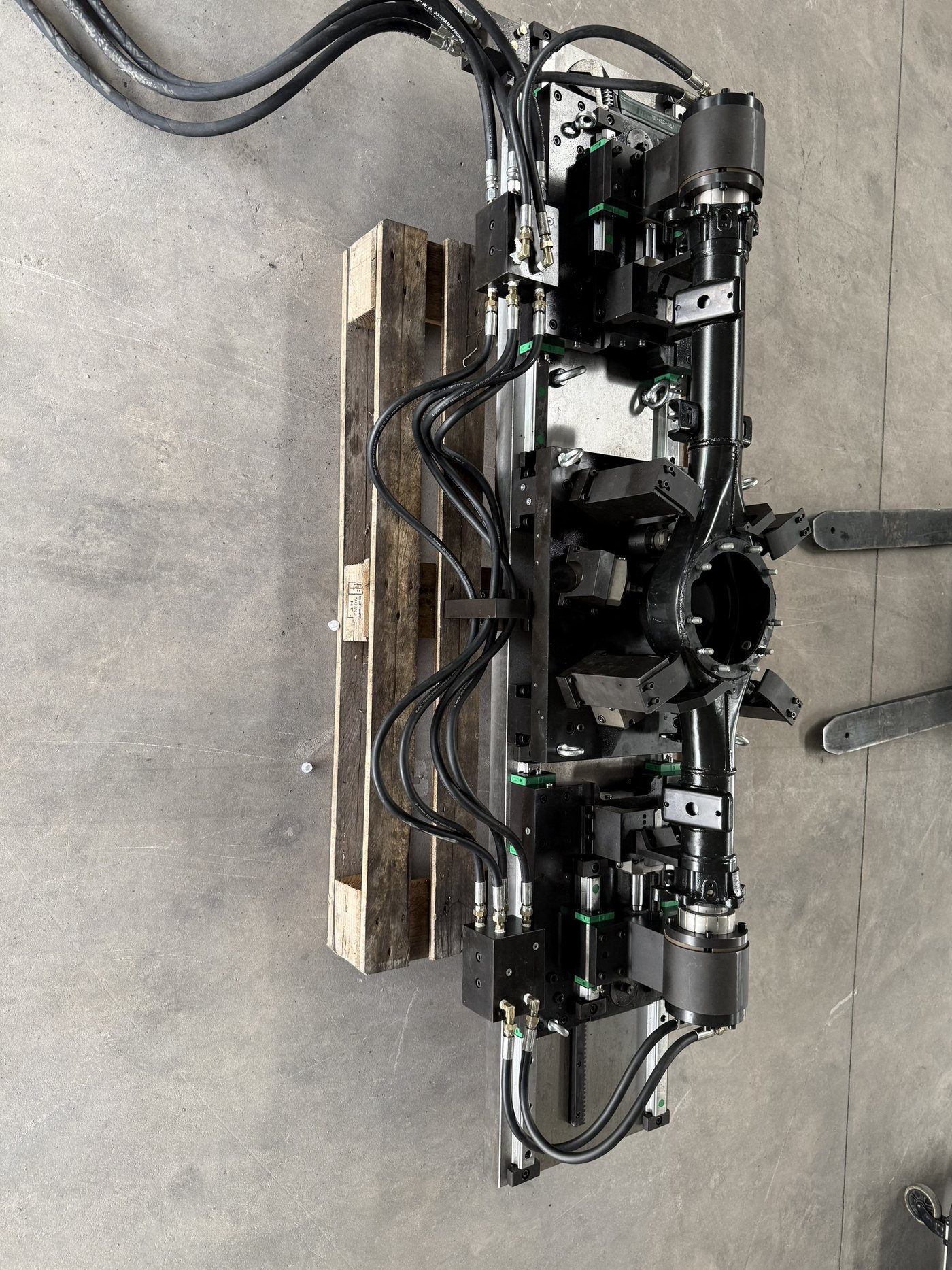
What can be specified
| Item | Range |
|---|---|
| Clamping element | Air vise, pneumatic swing clamp, diaphragm clamp, or bellows cylinder |
| Line pressure | 0.5–0.7 MPa (5–7 bar) typical; below 0.4 MPa holding force is unreliable in roughing |
| Holding force | 3–12 kN per clamp typical, depending on bore and pressure |
| Actuation time | 0.3–1 s per stroke — the fastest of the three clamping methods |
| Stations | 1 to 12 per fixture; air is cheap to distribute, so station count costs less than hydraulics |
| Confirmation | Pressure switch plus position sensing; a timer is a fallback, not a signal |
| Air quality | Filtered and dried; moisture in the line shows up as erratic clamping before it shows up as anything else |
| Repeatability | Clamp-to-clamp force variation typically within ±8% — wider than hydraulics because air is compressible |
| Delivery package | Drawings, BOM, pneumatic circuit, valve and I/O list, trial-cut report |
Figures marked “typical” are the values this class of fixture normally holds in production. Actual values are fixed on the drawing, not on this page.
Where pneumatics win
Three cases, and they are all about speed rather than force.
- Aluminium and thin-wall parts. Lower force is an advantage: the part does not deform under the clamp. A pneumatic clamp with a regulated line holds a 3 mm wall without crushing it, where a hydraulic clamp has to be turned down to do the same.
- High-changeover, high-mix work. Air cylinders stroke in a fraction of a second and the valving is simple, so a fixture with six clamps on a quick-change plate re-clamps in under two seconds.
- Long fixtures with many stations. Distributing air across a 2 m fixture costs almost nothing; distributing 300 bar hydraulic oil across the same distance costs manifolds, thick tube and leak risk.
Where pneumatics lose is equally predictable: heavy roughing in steel or cast iron, deep pockets with a long tool overhang, and any cut where the part has to be held against a force the air line cannot generate.
The compressibility problem
Air is springy, and that shows up in two places.
Force varies with pressure, and pressure varies with demand. When a second machine on the same line fires, the pressure at your fixture drops for a moment. A regulator at the fixture with its own gauge and a check valve isolates you from that; without them, clamp force is a function of what the rest of the shop is doing.
Position is not guaranteed by pressure. A pressure switch confirms pressure in the circuit, not that the clamp reached the part. On a pneumatic fixture the gap between those two statements is larger than on a hydraulic one, because the air compresses before the clamp moves. Use a position sensor where seating matters.
What this is not for
- Not for heavy roughing in steel or cast iron. The force is not there, and turning the regulator up does not create it.
- Not for shops with wet, oily or unregulated air. Fix the air supply first; a pneumatic fixture on bad air is a maintenance contract.
- Not for unattended running without confirmation. Air leaks silently and a clamp relaxes without an alarm unless something is watching.
Send a drawing. Get a clamping scheme and a price band.
What speeds this up: the workpiece drawing (STEP plus a PDF with datums and tolerances), the machine model, the operation sequence, the cycle time you are targeting, and the annual quantity. Without those you get a band; with them you get a number.