Fixtures / Hydraulic fixtures
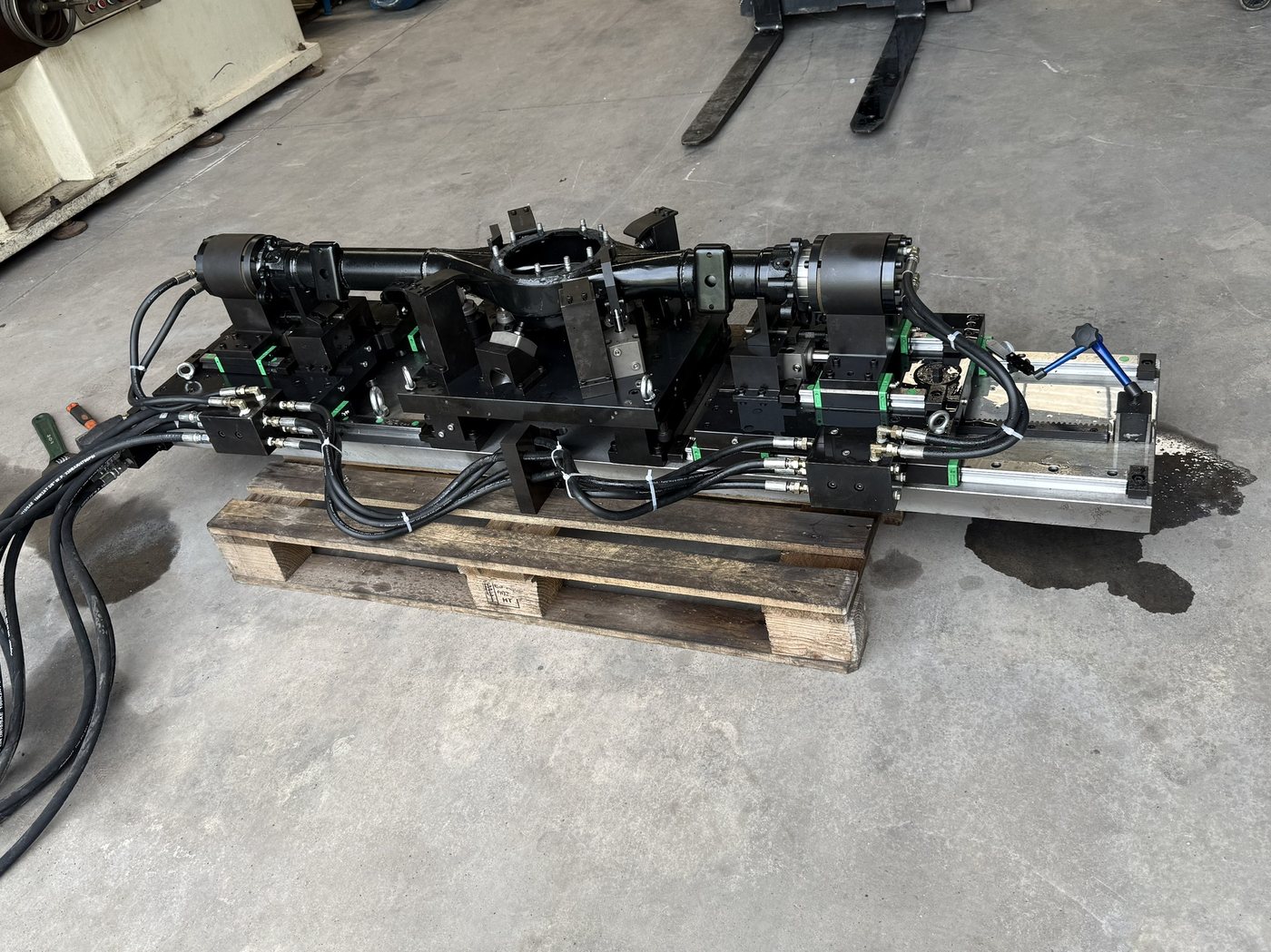
Hydraulic clamping fixtures
Hydraulic clamping earns its cost when the cut is heavy, the cycle is long, or nobody is standing at the machine. Below that threshold it is an expensive way to do what a manual clamp already does.
At a glance
What it is: a fixture with hydraulic cylinders or swing clamps, fed from a power unit through a valve block, with clamp confirmation wired back to the machine control.
Price band: USD 7,000–16,000 FOB China for a dedicated single-station hydraulic fixture; USD 16,000–45,000 for multi-station or tombstone sets. The power unit is a line item — if a quote does not mention it, ask whether it is included.
Lead time: 6–10 weeks from approved drawing, including trial cut.
The number people get wrong: flow, not pressure. Eight clamps moving together need 0.3 L in about a second and a half — roughly 12 L/min, which is the top of the range for a machine-tool clamping power unit. The accumulator covers the stroke; the pump covers the average.
Specify the fixture and the power unit as one decision. Bought separately, they are sized against different assumptions and the clamp cycle is the thing that pays for it.
What can be specified
| Item | Range |
|---|---|
| Clamping element | Swing clamp, link clamp, block cylinder, or pull-down cylinder — 6.8–41 kN per element typical |
| Working pressure | 250–350 bar typical, elements rated to 500 bar max |
| Stations | 1 to 8 per fixture; multiple fixtures per pallet on an HMC |
| Actuation time | 1–3 s per complete clamp stroke, set by the accumulator and valve sizing |
| Clamp confirmation | Pressure switch per circuit plus a position sensor where seating matters |
| Interlock | User M-codes mapped to the machine PLC; program holds until every clamp confirms |
| Power unit | 0.75–3.0 kW motor, 0.9–12 L/min, 11–63 L reservoir (typical) |
| Accumulator | Sized twice: adiabatic for the clamp stroke, isothermal for holding against leakage |
| Repeatability | Clamp-to-clamp force variation typically within ±5% on a regulated circuit |
| Delivery package | Drawings, BOM, circuit diagram, M-code and PLC input list, trial-cut report |
Figures marked “typical” are the values this class of fixture normally holds in production. Actual values are fixed on the drawing, not on this page.
When hydraulic actually pays
Four conditions justify the cost. Meeting two of them is usually enough.
- The cut is heavy enough to move a manual clamp. Roughing cast iron or steel with a large cutter produces forces that a hand-tightened strap does not resist for a full cycle.
- The cycle is long enough that a loose clamp costs a part. A twenty-minute cycle with a clamp that relaxes at minute eight is a scrap generator.
- The fixture runs unattended or lights-out. This is the strongest case. Clamp confirmation is what makes unattended running possible at all.
- Changeover is frequent. Hydraulic clamping with a quick-change sub-plate turns a 40-minute re-clamp into a pallet swap.
If none of those apply — aluminium parts, light finishing cuts, an operator at the machine — a pneumatic or manual fixture does the same job for a third of the money, and does it faster.
Two circuits, not one
The most common design mistake on a hydraulic fixture is putting supports and clamps on the same hydraulic circuit. They then fight: the support pushes as the clamp pulls, the part is loaded from two directions at once, and the flatness result is worse than with no support at all.
Separate the circuits. A sequence valve holds the clamp circuit closed until the support circuit reaches its set pressure, and the machine control confirms both independently before the spindle starts. This costs one extra valve block and one extra input, and it is the difference between a fixture that holds a part flat and one that holds it somewhere.
What this is not for
- Not for low-volume prototype work. The design and build cost does not amortise over ten parts.
- Not for parts with no defined datum. Hydraulic force amplifies a bad location decision; it does not fix it.
- Not a guarantee of flatness. If the part is not supported where it deflects, more clamp force makes the problem worse, not better.
Send a drawing. Get a clamping scheme and a price band.
What speeds this up: the workpiece drawing (STEP plus a PDF with datums and tolerances), the machine model, the operation sequence, the cycle time you are targeting, and the annual quantity. Without those you get a band; with them you get a number.